 March 2026
High-Load Strength Training: Safe During Pregnancy?
High-load resistance training (HLRT) entails Olympic lifts like heavy squats, clean and jerks, and snatches plus lots of intense core work. But the medical community knows little about its effect on the pregnant woman’s body. We’ve discussed some of these exercise-pertinent concerns here in a previous newsletter.
Legitimate obstetric concerns about pelvic floor health and risk of miscarriage during the first trimester lend themselves to advise caution in the absence of data. Just as the American College of Obstetrics and Gynecology (ACOG) warned against excessive cardio exercise from the early 1980s to the early 2000s in the absence of firm data, today OB/GYN’s rightfully are reluctant to offer guidance to women who enjoy HLRT.

Canadian researchers surveyed 359 women from preconception to 12 weeks of gestation who had been participating in HLRT on a variety of concerns. Training frequency decreased from 4.8+/-1.0 days per week to 4.0+/-1.3 days per week that first trimester. While most continued Olympic lifting, remarkably 62% of them increased or maintained the intensity of their regimens. This despite the fact that 77% also experienced fatigue and nausea during that period. Miscarriage rates were similar to those of the general population. Pelvic floor complaints actually were “reduced significantly” irrespective of whether loads were reduced or maintained.
While this data does not prove that HLRT is safe during the first trimester, nor does it say anything about continuing intensive training beyond it, it does say that continued training is well tolerated by those who were doing so before they got pregnant. This is similar to what the ACOG guidelines say about cardio training: early pregnancy may not be the best time to start a training program but, barring other medical concerns, it’s an ok time to continue it.
MSSE Feb. 2026
Long-Distance and Competitive Runners NEED Strength Training
Strength training (ST) has demonstrated improvements in running economy (RE) during non-fatiguing, moderate-intensity runs. RE is a function of how much oxygen is needed to perform at a specific intensity so the lower the O2 requirement at the same relative intensity, the better. However, no studies have compared RE durability during marathon race intensity or during the high intensity of the final stages of a competitive race. A British lab quantified the effect of a 10-wk ST program on RE throughout a 90 min high intensity run and then a time to exhaustion (TTE) run at 90% of the subjects’ maximal aerobic capacity.b We have addressed RE in previous posts here, here and especially here.
Training consisted of maximal strength and plyometric (jump) exercises twice a week for 10 wks. Twenty-eight well-trained male runners were split into an Endurance only (E) and a ST+E group. The E+S improved RE by -2.1% (less O2 required) vs 0.6% (more O2 required) in the 90 min run. Furthermore, the E+S improved their TTE by a whopping 35% compared to a -8% (in other words, a decrease) in those who continued their running routines.
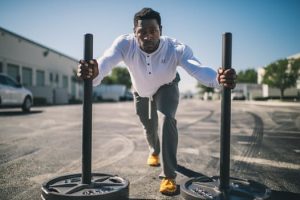
The results of this study of ST for runners are very positive. More granular studies are needed to figure out why ST is so beneficial. Is it the development of stronger fast twitch fibers; the “attenuated rise in neuromuscular activation” such that fewer fast twitch fibers are involved throughout the race, especially at the final sprint; or increased tendon stiffness which provides a passive force to muscle contractions much as a spring is loaded? Stay tuned.
MSSE July 2025
Tid Bits
You would think by now that exercise science would have solved the question of what causes strength gains after a period of resistance training (RT). Is it increased muscle size or improved neuromuscular activation of the muscles themselves? After a 15 wk RT program, “very strong …correlations were found between muscle growth and strength gains” to the tune of a >5-fold impact compared to improved neuromuscular activation. MSSE Dec. 2025
Who wants bigger thighs? Obviously those who train their muscles for strength and growth. A Japanese study compared the hypertrophic differences between leg press (LP) and knee extension (KE) exercises. A 10 reps/set, 5 sets/session, 2 sessions/wk, 12-wk program found that the muscle volumes (as measured by MRI) of individual and whole quadriceps muscles increased significantly although the rectus femoris was most-improved in the leg doing KE. Only the LP increased the volume of the gluteus maximus and adductor magnus. In sum, the LP is a “highly time-efficient exercise”. MSSE Feb. 2026
It’s long been the standard belief that therapy for anterior cruciate ligament (ACL) tears and repairs should be done with what are called closed kinetic chain (CKC) exercises like squats, lunges, and step ups. Open chain (OKC) exercises like knee extensions were taboo for fear that they would strain the injured or freshly-repaired ACL. A recent meta-analysis of 21st century studies assessed such outcomes of interest as tibial laxity (a sign of ACL loosening), strength and function. Low-to-moderate-quality evidence found no differences in either of those endpoint. Moderate-quality evidence demonstrated no differences in any of the relevant measures with early or late introduction of OKC compared to CKC at all follow-up time points. So work those quadriceps early, once the doc says ‘go’. JOSPT July 2018