 October 2026
Aging Runners Need Science’s Help
Runners, and that includes joggers, have many reasons to continue their training, from health to pure joy…maybe even neurosis. But change happens and science has been struggling to determine how and why. We’ve known for decades that specific heart-related changes occur regardless of one’s training though at different rates compared to those who do not train. We’ve learned over the past 20 years that the calf muscles – the gastrocnemius which are the power ankle muscles and the soleus, under the gastrocs, which is the endurance muscle – lose strength and power even in middle age runners, despite years of training. This leads to slower, less buoyant gait; specific exercises help, such as heel raises, but still older runners run slower.
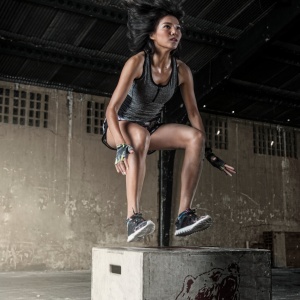
Two very recent studies might help keep some of the spring in your step, or at least slow down its loss. One (MSSE Sept. 2026) looked at plyometric exercises like jumping from a box to identify neuromuscular and biomechanical factors associated with running economy improvements in male masters runners. A 3 month training program was tested by having them run at 80% of their maximal O2 capacity for 30 minutes. Running economy improved in 77% of the athletes by ~3.9%: that is, it took almost 4% less energy to complete the task after plyometric training.
“Enhanced reactive jump ability combined with a reduced step frequency” resulted from jump training.
Another study looked at biomechanical changes between 2 gait modifications: cues to run softly (SOF) or shifting to a forefoot strike pattern (FFS). Both techniques have been found to reduce knee pain and injury. It turns out that SOF was a viable cue that reduced knee and ankle loading and knee stiffness, despite putting more load on the hip joints. (MSSE Sept. 2026)
Testing Body Composition in the Elderly: DEXA Wins
There are many ways to measure one’s body composition – skinfold calipers, bioelectric impedance, underwater weighing, ultrasound – but all are based on regression equations that merely approximate one’s lean body mass (LBM: muscle, bone, organs, blood) and one’s fat mass (FM). These equations, however, were based on large data sets of mostly younger, under-60, people. In the early days of testing, everything was compared to the gold standard of underwater weighing, which was based on Archimedean science.
But almost all formulae didn’t account for the natural changes in the older population. That is, the natural loss of muscle mass from aging alone – despite the benefits of resistance training in slowing that loss – disrupts the linearity of body comp decline over time.
More recently, DEXA scans – dual energy X-ray absorptiometry (same thing women get for osteoporosis evaluation) – have become the new gold standard. A recent study attempted to fine tune the data from DEXA measures in older women using a statistical mechanism called Elastic Net regression.
They obtained total and regional FM and LBM in 523 older women from measures of body mass, skinfolds, circumferences, and DEXA.
Elastic Net equations provided accurate measures of total body composition and moderately useful measures of regional (think lower body, trunk, etc.).
While the results still support the primacy of DEXA, the authors caution that “prediction equations should be interpreted as internally validated models intended primarily for screening and research applications.” In other words, DEXA is close but no cigar except for screening and research.
MSSR Sept. 2026
Tid Bits
In a study comparing cartilage composition, morphology, and subjective reports of knee function among 183 age- and sex-matched joggers (J), non-joggers (NJ), and obese individuals (O), joggers win: they had better quality and more knee cartilage than both NJ and O. Obese subjects had a “lower prevalence of normal cartilage” on the medial/inner side of the tibia with up to 4X the odds of abnormal findings; scores on knee function and pain were lower than those of J and NJ. Jogging and walking keep knees healthy. MSSE Aug. 2026
Microplastics (MP), those super-small bits of plastic we ingest, even inhale, from all the sources of plastic used in packaging, like bottles, take-out foods, even our water., accumulate in the body. Some get excreted, but some still can be found in our blood and organs. A specific lactic acid bacterium – leuconostoc mesenteroides CBA3656 if you want to know – shows strong bioabsorption of MP, quickly, and outperforms other strains of bacteria in simulated and rodent experiments of intestinal excretion of them. And you can get these bacteria from kimchi, pickled Korean cabbage! Mindbodygreen Sept. 2006
A meta-analysis of 20 randomized controlled trials (RCT), accumulating 791 subjects, tried to “estimate the dose-response relationships between isotonic lower extremity resistance exercise [RE] volume and outcomes of pain, function, and strength in people with knee osteoarthritis (OA).” They also compared different intensities and delivery methods of RE. They found with low- to very-low certainty that isotonic RE, if using very light to moderate intensities, “produced the greatest reductions in pain; moderate-intensity, the greatest improvements in function; and moderate- to vigorous-intensity, similar gains in muscle strength.” Training in a fitness center did yield greater benefits compared to home-training. Total rep ranges for specific improvements were found though with low to very low certainty. JOSPT Sept. 2026